EU’s new AI labelling icons: what they mean for transparency and compliance
In May 2025, the European Commission released a set of optional icons designed to help organizations label AI-generated or manipulated content. These icons are part of the broader effort to support transparency under the EU AI Act, which comes into full force in August 2026. While their use is not mandatory, they provide a standardized way to disclose AI involvement in content—helping organizations meet regulatory requirements while maintaining public trust.
For HR, compliance, and risk leaders, these icons are more than just visual cues. They represent a critical tool in the broader governance framework needed to manage AI risks, ensure accountability, and avoid regulatory pitfalls. Below, we break down what these icons are, when they apply, and how to implement them effectively.
Is your business EU AI Act Compliant? Check yourself for free
NEW & FREE: Take our short 5 minute assessment to get a preliminary understanding of where you stand with EU AI Act's Compliance.
What are the EU’s AI labelling icons?
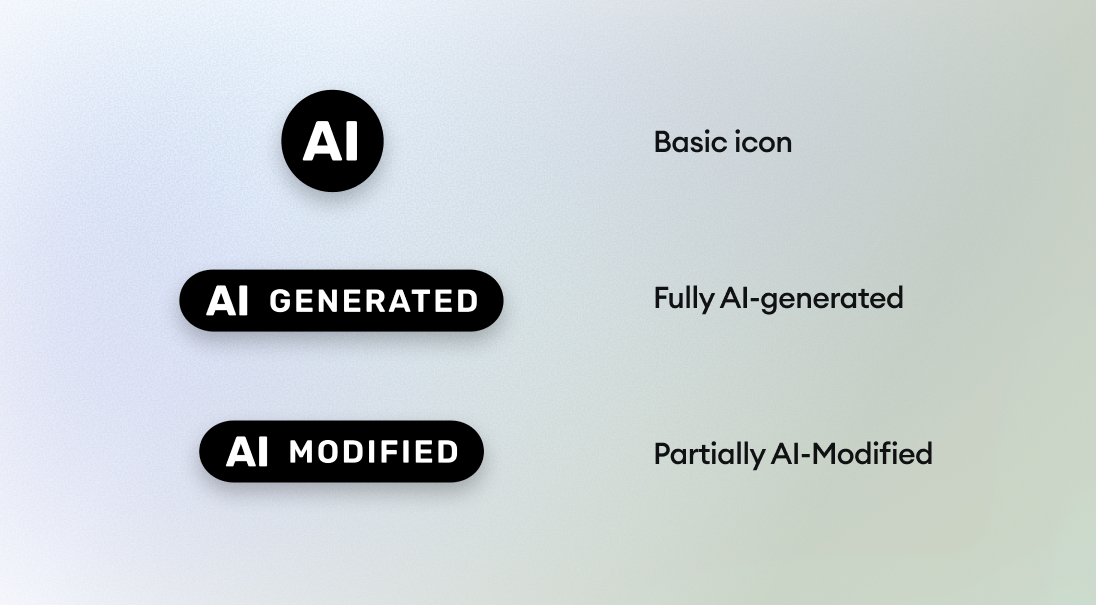
The EU’s AI labelling icons are a set of visual symbols designed to help natural persons (i.e., individuals) recognize when content has been generated or manipulated by AI. They are part of the Code of Practice on marking and labelling of AI-generated content, which aligns with Article 50(4) of the AI Act. The icons are freely available in four variations (black, white, black with 50% transparency, and white with 50% transparency) and two formats (SVG and PNG).
User testing has shown that these icons are most effective when paired with a text label (e.g., "modified" or "AI-generated"). This combination improves clarity and ensures that users—regardless of their technical background—can easily understand the nature of the content they’re consuming.
The three icon types and their use cases
The EU has defined three distinct icons, each addressing a specific scenario:
Basic icon
When to use: When AI was involved in creating deepfake content (image, audio, or video) or published text, or when a custom text label or interactive second layer is implemented.
Use case examples:
A deepfake video with the text label "voices generated with" followed by the basic icon.
An AI-assisted news article where the basic icon is used alongside a disclosure like "AI-assisted editing."
Fully AI-Generated
When to use: When the entire content (image, audio, video, or text) is fully generated by AI with no human-created elements or editorial control (apart from prompting).
Use case examples:
Fully AI-generated deepfake videos featuring politicians or fictional events.
AI-composed music or art (though artistic works may have limited disclosure requirements).
AI-generated news summaries or reports published without human review.
Partially AI-Modified
When to use: When pre-existing, human-made content has been partially modified by AI, turning it into a deepfake or text on matters of public interest.
Use case examples:
A face in an authentic photograph is swapped with a politician’s face using AI.
An authentic photograph of an empty apartment is furnished using AI.
What content must be labelled under the AI Act?
The AI Act’s transparency requirements under Article 50(4) mandate that certain AI-generated or manipulated content must be disclosed. The EU’s icons are designed to support compliance with these requirements, but they are not a substitute for legal adherence. Organizations remain responsible for ensuring their disclosures meet the Act’s standards.
Here’s what needs to be labelled:
Deepfakes: AI-generated or manipulated image, audio, or video content that resembles existing persons, objects, places, entities, or events and would falsely appear to a person to be authentic or truthful. Examples include:
AI-generated videos of public figures making statements they never made.
AI-manipulated audio clips of executives or employees.
AI-generated text on matters of public interest: Text published to inform the public on topics of public interest that did not undergo human review or editorial control and where no legal or natural person assumed editorial responsibility. Examples include:
AI-generated news articles or reports on political, social, or economic issues.
AI-drafted public statements or press releases without human oversight.
Limitations and exceptions
Not all AI-generated or manipulated content requires labelling. The AI Act includes several exceptions where disclosure obligations are limited or waived:
Artistic, creative, satirical, or fictional works: Where deepfake content is part of an evidently artistic, creative, satirical, fictional, or analogous work, the transparency obligations are limited to disclosure in a manner that does not hamper the display or enjoyment of the work. For example:
A satirical deepfake video used in a comedy sketch may not require the same level of disclosure as a manipulated news clip.
AI-generated art or music may have reduced disclosure requirements if the artistic intent is clear.
Legally authorized uses: The disclosure obligation does not apply where the use of deepfakes or published text on matters of public interest is authorized by law to detect, prevent, investigate, or prosecute criminal offences. For example:
Law enforcement agencies using AI-generated content for undercover operations or investigations.
Human review or editorial control for text: The disclosure obligation does not apply where AI-generated text has undergone a process of human review or editorial control and where a natural or legal person holds editorial responsibility for the publication. For example:
An AI-drafted internal report that is reviewed, edited, and approved by a human before publication.
A news article where AI assists in drafting but a human editor assumes final responsibility.
How to display the EU icons effectively
The EU’s Code of Practice on marking and labelling of AI-generated content provides detailed placement specifications for the icons. While the icons are optional, organizations that choose to use them must ensure they are displayed in a way that is clear, accessible, and compliant with the AI Act. Below are the key rules for displaying the icons:
Visibility at first exposure: The icon must be clearly perceivable and distinguishable at the latest when a natural person is first exposed to the deepfake or published text. This ensures users are immediately aware of AI involvement.
Direct embedding or equivalent alternatives: The icon should be directly embedded into the deepfake or published text (except for creative works), unless equivalent alternatives—such as a user interface overlay—are available. The icon must remain visible even when the content is reshared or downloaded.
Accessibility measures: Organizations are encouraged to implement the following accessibility best practices:
The icon should be displayed in a clearly visible size.
Any accompanying label should use plain language and avoid jargon, confusing wording, or abbreviations (other than "AI").
The icon should be readable by assistive technologies using alt text or ARIA labels (e.g., "This content is AI-generated or manipulated").
If the disclosure appears for a limited time, it should remain visible long enough to be read and understood by users with cognitive or processing difficulties.
If additional information is provided through a second interactive layer (e.g., a tooltip or pop-up), the icon should clearly indicate that further information is available, and the second layer should be navigable using assistive technologies.
For signatories of the Code of Practice, adherence to these placement specifications is mandatory. Non-signatories are free to use the icons but should avoid implying adherence to the Code unless they comply with its requirements.
Why these icons matter for HR, compliance, and risk leaders
The EU’s AI labelling icons are more than a compliance checkbox—they are a critical component of a broader AI governance strategy. For HR, compliance, and risk leaders, they serve several key functions:
Mitigating misinformation risks: AI-generated content, particularly deepfakes, can spread misinformation rapidly, damaging an organization’s reputation or even influencing public opinion. By clearly labelling AI-generated content, organizations can reduce the risk of their content being misused or misinterpreted.
Ensuring regulatory compliance: The AI Act imposes strict transparency requirements, and failure to comply can result in fines of up to 7% of global revenue. While the icons themselves do not guarantee compliance, they provide a standardized way to meet disclosure obligations. Leaders must ensure that any labelling—whether using the EU icons or alternative methods—aligns with the Act’s requirements.
Maintaining public trust: Transparency is key to building and maintaining trust with employees, customers, and stakeholders. By proactively disclosing AI involvement in content, organizations demonstrate their commitment to ethical AI use and accountability.
Supporting internal governance: For organizations using AI internally—such as in HR processes, internal communications, or training materials—clear labelling helps employees understand when they are interacting with AI-generated content. This is particularly important for high-risk use cases, such as AI-assisted hiring or performance evaluations, where transparency is critical for fairness and compliance.
Key considerations for implementation
While the EU’s icons provide a useful tool for compliance, their implementation requires careful planning. Here are some key considerations for HR, compliance, and risk leaders:
Align with broader AI governance frameworks: The EU’s icons should be integrated into your organization’s broader AI governance strategy. This includes policies for AI use, risk assessment frameworks, and employee training programs. For example, if your organization is pursuing ISO 42001 certification, ensure that your labelling practices align with the standard’s requirements for transparency and accountability.
Educate employees and stakeholders: Transparency is only effective if users understand what the icons mean. Provide training for employees, content creators, and other stakeholders on when and how to use the icons, as well as the broader implications of AI-generated content.
Monitor regulatory developments: The AI Act is just one piece of the global regulatory landscape for AI. Stay informed about emerging regulations, such as the EU’s Digital Services Act or industry-specific guidelines, to ensure your labelling practices remain compliant.
Leverage technology for enforcement: Manually labelling AI-generated content can be time-consuming and prone to errors. Consider using AI governance platforms, like DocsOrb, to automate the labelling process, enforce policies, and ensure consistency across your organization.
What’s next for AI transparency?
The EU’s AI labelling icons are a step toward greater transparency in AI-generated content, but they are just the beginning. As AI adoption continues to accelerate, organizations will face increasing pressure to disclose AI involvement in a way that is clear, accessible, and compliant with evolving regulations.
For HR, compliance, and risk leaders, the message is clear: transparency is no longer optional. Whether you choose to use the EU’s icons or develop your own labelling system, the key is to act now. Start by assessing your organization’s AI use cases, identifying where labelling is required, and implementing a governance framework that ensures compliance and accountability.
By taking a proactive approach to AI transparency, you can mitigate risks, build trust, and position your organization as a leader in ethical AI use—before regulators demand proof.